ADR CS2 Explained: Meaning, Formula and Good ADR
ADR in CS2 is one of the most useful stats for understanding your real impact in a match. It goes beyond kills and shows how much damage you consistently deal across rounds. In this guide, we break down what ADR means, how it’s calculated, and what numbers actually count as good performance.
If you’ve spent any time checking your stats in Counter-Strike 2, you’ve probably come across ADR. It’s one of those numbers that seems important, but not everyone really understands what it tells you.
What ADR Stands For
In simple terms, ADR means Average Damage per Round. So, what is ADR in CS2? It is a stat that tracks how much damage you’re dealing across a match – not just whether you get the kill at the end.
The math behind it is pretty straightforward: you take all the damage you dealt and divide it by the number of rounds played. That’s it. But the interesting part is what that number actually says about your gameplay.
ADR = Total Damage Dealt / Total Rounds Played
Let’s say you deal around 1200 total damage over 15 rounds. That puts you somewhere near 80 ADR. On paper, it might not look that impressive. But in practice, it means you’re consistently softening enemies, setting up kills, and making life easier for your team – even if your name isn’t always at the top of the scoreboard.
And that’s really the key idea here. You don’t have to win every duel to be useful. Even landing 70–90 damage before going down can completely swing a round.
Why ADR Matters in CS2
Here’s the thing – kills don’t tell the full story. They show who finished the fight, but not who did most of the work.
CS2 ADR fills in that gap.
You might hit an opponent for 90 damage and then get traded instantly. From a K/D perspective, that looks like a loss. But in reality, you’ve practically guaranteed that your teammate gets an easy kill right after. That kind of contribution adds up quickly, and CS2 ADR captures it.
It’s also a pretty good indicator of consistency. Players sitting around 70+ ADR are usually involved in most rounds in some way. On the other hand, someone with low ADR might only show impact in a few isolated moments.
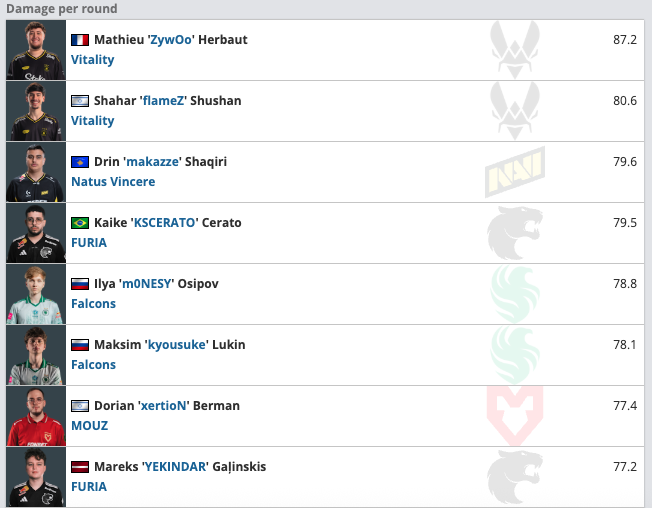
If you look at higher-level games, ADR becomes even more relevant. Roughly speaking, anything around 70–90 is considered solid. Once you start pushing above that, you’re having a genuinely strong match. And if it climbs past 100, you’re probably dominating the server.
At the same time, context still matters. Entry players tend to have higher ADR because they’re taking the first fights and dealing damage early. Support players might sit lower, but that doesn’t automatically mean they’re underperforming – they just contribute differently.
You can check your ADR directly on the in-game scoreboard during a match. Open the scoreboard and look for the ADR column. It shows your average damage per round for that specific game.
After the match, you can also review ADR in the match stats screen if the data is available. Some players prefer third-party tracking platforms like Leetify, CSStats, or FACEIT stats, since they usually show ADR across multiple matches, not just one game.
ADR vs Other CS2 Stats
A lot of players naturally focus on K/D or total kills. It makes sense – those numbers are easy to understand. But they don’t always reflect what’s actually happening in a round.
K/D, for example, only tracks outcomes. You either got the kill or you didn’t. It ignores all the damage you dealt beforehand. You could consistently weaken enemies and still end up with an average or even negative K/D.
Total kills have a similar issue. You might end a match with 20 kills, but if many of those were low-damage finishes, your overall contribution might not be as high as it looks.
Headshot percentage is another stat people like to bring up. It says something about your aim, sure – but it doesn’t tell you how often you’re actually dealing meaningful damage.
ADR CS2, on the other hand, pulls all of that together. It counts weapon damage, utility damage, chip damage – everything. That’s why it often gives a more honest view of your impact.
How to Improve Your ADR in CS2
If you’re trying to raise your ADR, it’s less about chasing kills and more about staying consistently involved in rounds.
First of all, you need to actually take fights. Playing too passively might keep you alive longer, but it won’t help your numbers much. At the same time, blindly rushing into bad situations doesn’t work either. The goal is to find smart engagements – peeking with teammates, trading efficiently, and avoiding situations where you’re likely to get eliminated without doing damage.
Another thing that often gets overlooked is utility. Grenades can quietly boost your ADR more than you’d expect. A well-timed HE can deal 20–50 damage to multiple players, and molotovs can force enemies out of position or chip away at their health. Over a full match, that damage really adds up.
Positioning also plays a big role. If you’re constantly getting caught in the open or facing multiple opponents at once, your chances of dealing consistent damage drop fast. Holding angles where you can fall back, or playing spots that give you more than one opportunity to fight, makes a noticeable difference.
And yeah, staying alive matters. Not just for survival, but because the longer you’re in the round, the more chances you get to deal damage. Even late-round situations like retakes or post-plants can push your ADR higher if you’re still around to take part in them.
What is a good ADR in CS2?
- Below 60 → low impact
- 60–70 → average
- 70–90 → good
- 90+ → exceptional performance
Articles by this author